
Application
Voltage Stabilizer for CT, DR and X-Ray Rooms
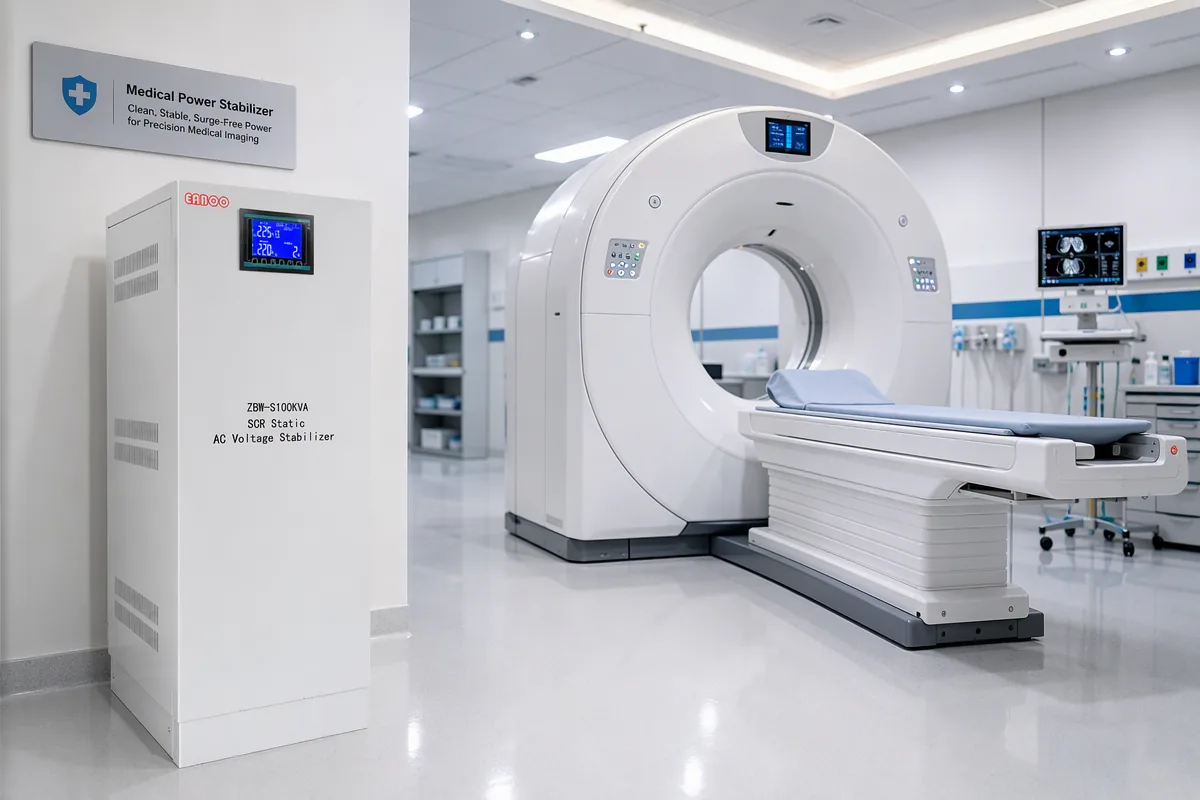
An imaging room is not a continuous load. A CT or DR system draws a very large current for a fraction of a second while the tube is energised, and a scanner that sees the supply sag at that moment produces noise, repeats the exposure or aborts it. The stabilizer has to answer in milliseconds.
What the load actually looks like
A CT, DR or X-ray room spends most of the day at low draw and then asks for a pulse many times larger than that. Averaging this over a day gives a figure far below the peak, which is why a unit sized on average load trips exactly when the room is working.
The second load in the same room is the support equipment: chiller, air handling, table and gantry drives. It runs continuously on the same supply. The support load decides the continuous rating while the exposure decides the surge requirement, and both have to sit inside one window.
What to specify
- Peak current during exposure, not the daily average: this fixes the surge rating.
- Correction speed: a static SCR unit corrects in milliseconds, a servo unit needs hundreds of milliseconds and lets the sag through.
- Accuracy of plus or minus 1 to 3 percent where images are compared over time; SCR units regulate each phase independently.
- Whether the room also needs an isolating or purified supply, not only regulation.
- The continuous ancillary load (chiller, HVAC), which adds directly to the kVA.
Two mistakes we see
- Sizing on the scanner nameplate alone and leaving the chiller outside the stabilizer, so the room trips on the load it cannot run without.
- Choosing a servo unit because it is cheaper per kVA: at the moment of exposure the output has not moved yet.
Frequently asked questions
How is capacity chosen for an imaging room?
From the peak current during exposure plus the continuous ancillary load. The largest single pulse sets the surge requirement; it should never be averaged away.
Can one stabilizer serve several modalities?
Yes, if it is sized on the sum of the peak demands, and if the modalities are interlocked so that two exposures cannot coincide on the smallest configuration.