
Application
Voltage Stabilizer for Printing and Packaging Lines
A press loses register when the supply moves. A sag on one leg shifts the image on one unit and the whole job becomes waste, so offset, flexo and packaging lines are usually regulated at the distribution board rather than at the machine.
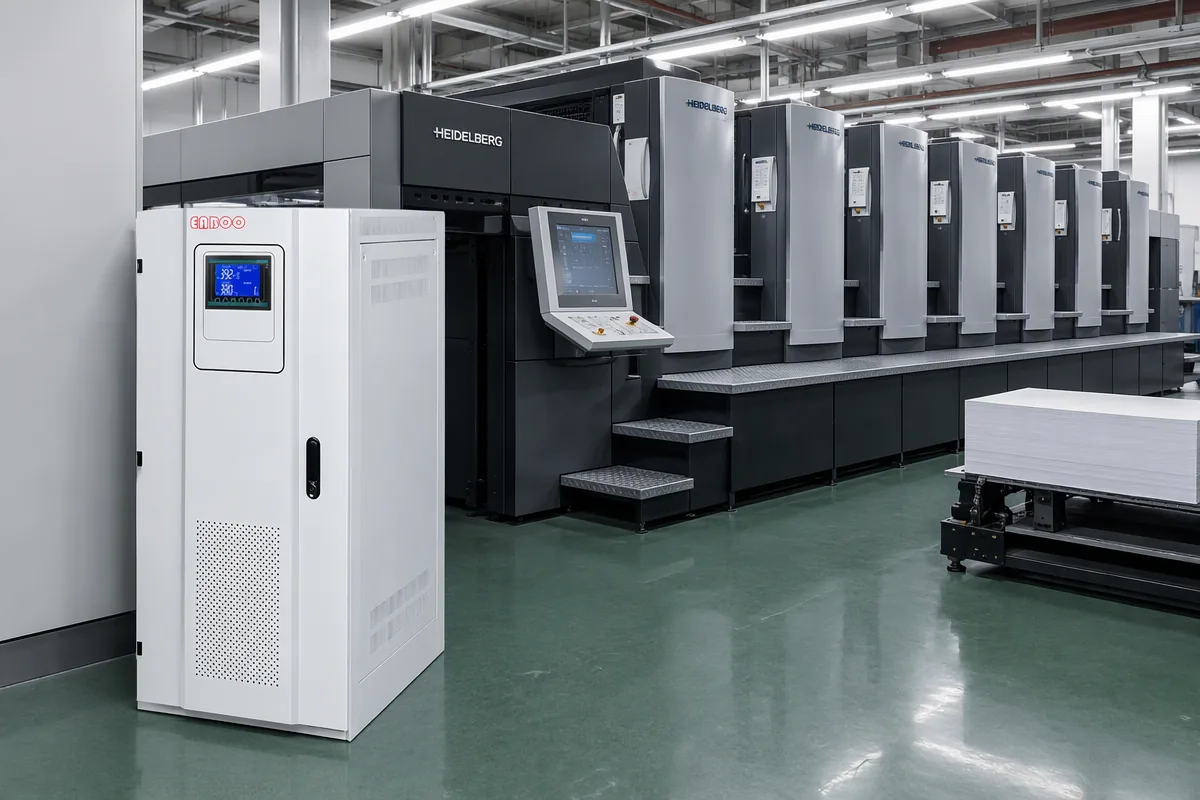
What the load actually looks like
A press is a continuous three-phase load with an electronic drive front end, plus drying: infrared, hot air or UV. The dryer is a large resistive load switched in steps, and it is the part most often left out of the sizing calculation.
Register accuracy is a mechanical tolerance measured in fractions of a millimetre, held by electronic drives. A supply that stays within a couple of percent keeps the job running; a supply that oscillates does not, even when the average is correct.
What to specify
- Total installed load including dryers and UV units, with the duty factor of the shift.
- How fast the dryer steps switch, because that sets the correction speed the line needs.
- Three-phase regulation with independent phases where single-phase loading is unbalanced.
- Continuous duty with reachable wear parts: a press runs shifts, so maintenance has to fit a planned stop.
- Whether the customer wants the stabilizer upstream of the whole board or only of the press line.
Two mistakes we see
- Regulating only the main drive and leaving the dryer on raw mains, so the sag returns every time the dryer steps.
- Sizing from the drive nameplate in kW without the power factor, which understates the kVA the stabilizer must pass.
Frequently asked questions
Servo or SCR for a press line?
A servo cabinet is the usual choice: the load changes slowly compared with an imaging room and the cost per kVA is lower. SCR is chosen when the dryer steps are fast, or when brush maintenance cannot be planned.
Where is the stabilizer installed?
Normally between the incoming supply and the press distribution board, so that drives, dryers and controls are all on regulated output and no load is left behind.