
Case Study: 45V–260V Stabilizer on a Weak Grid
What the site reported
Some remote areas in Tajikistan suffer from poor grid power supply. One local user reported that the no-load voltage at his residence was only 140V. After connecting a conventional stabilizer purchased from the local market, the voltage dropped sharply to 40V due to high line impedance. The stabilizer kept tripping and failed to work, as standard stabilizers cannot adapt to such extreme low-voltage grid conditions.
What we built
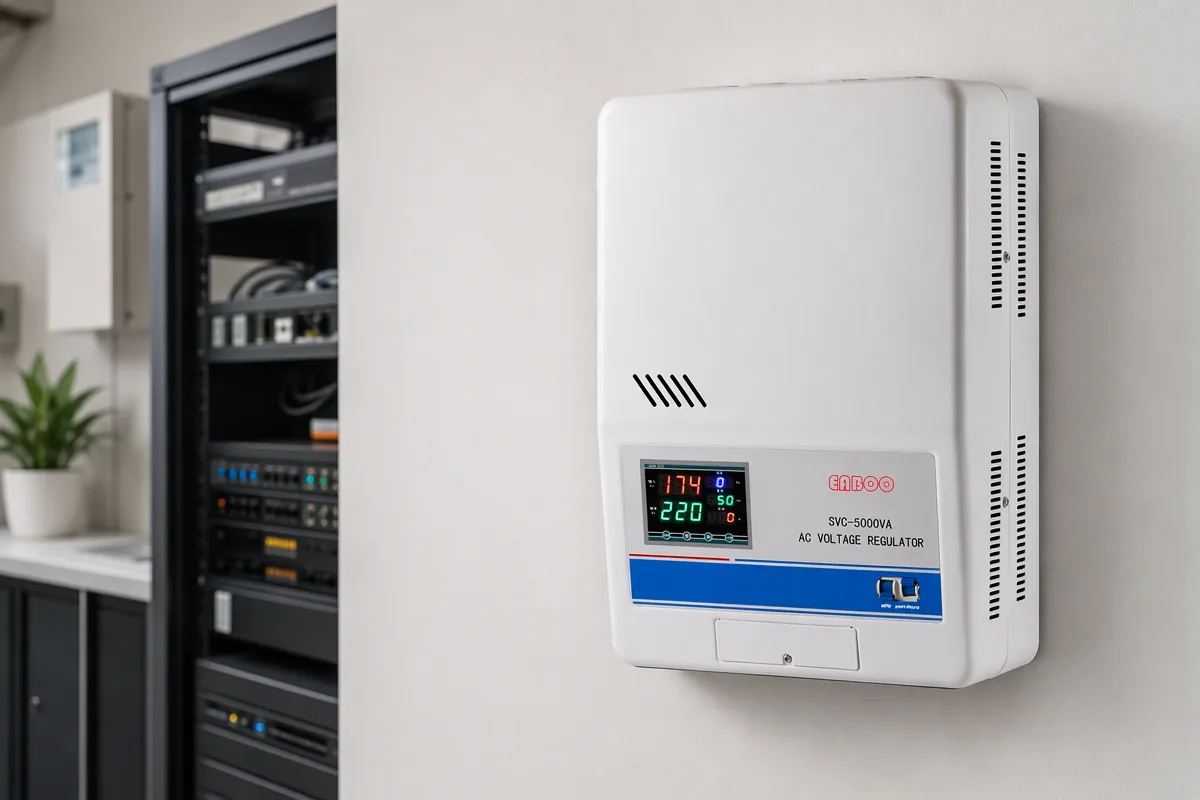
To solve this challenging low-voltage issue, our technical team carried out dedicated analysis and research. We developed this cost-effective AC voltage stabilizer specially for buyers with limited budgets. Equipped with zero-cross switching and soft-start functions, this stabilizer features an ultra-wide input range of 45V–260V. It is designed for grids with severe undervoltage and large line voltage drop, fundamentally solving the problems of stabilizer failure and tripping under low input voltage.
Result and how to read the case
The unit runs reliably after delivery, and the customer is highly satisfied with the performance. When the measured site voltage sits inside the catalogue window, a standard three-phase industrial stabilizer is normally sufficient; when it falls outside that window — 45V at the bottom end here — the unit is specified as a custom build. Capacity is still calculated the same way as any other project: see how to size a stabilizer.
Where this fits
The measurement behind this case is 140V at no load and 40V under load, which is a load-induced collapse rather than a low average voltage. If your site shows the same pattern, read what a stabilizer can and cannot fix at 40V first, then whether an 80V or a 100V floor is enough for the standard units. Both articles explain the same physics that drove the custom 45-260V build described above.
Case study · Weak grid