
400V to 380V Transformer: 400/415/440V Export Grids
415V at the terminals
A machine built for 380V, 50Hz lands in a plant measuring 415V between phases. The meter meant to prove the supply fine proves the opposite: the contactor coil buzzes, the 220V control circuit reads 240V. Nothing has failed, yet the machine runs outside its nameplate.
Three problems wearing one coat
A steady ratio. The error is a proportion. 400V is 1.053 times 380V, 415V is 1.092, 440V is 1.158. Everything downstream multiplies it: a 220V control winding on the same supply gives 240V at 415V and 254V at 440V.
Frequency. Core flux follows voltage over frequency. A 380V 50Hz winding needs about 20 percent more flux than at 60Hz, and no transformer changes that.
Variation. A nameplate is a window. If the feeder moves between 390V and 424V across a shift, a fixed device is right for one number.
The numbers that decide
Divide the worst measured value by 380. 400V gives 1.05, just outside the ±5 percent band IEC 60034-1 calls zone A for motor duty; 415V gives 1.09, inside zone B; 440V gives 1.16, outside both.
Measure at the machine terminals through a loaded and an unloaded day: a 400V nominal supply swings several percent, so it can hit 424V.
Capacity is throughput. Current is S over root three times U, so 1kVA is 1.52A at 380V, 1.44A at 400V and 1.31A at 440V. A 100kVA load draws 152A at 380V and 131A at 440V: the ammeter looks comfortable while the insulation does not.
An autotransformer winding carries only the difference: 1 minus U2 over U1 is 13.6 percent for 440 to 380 and 8.4 percent for 415 to 380, which is why it is smaller than an isolation unit of equal throughput. Check whether the nameplate figure is throughput or winding rating.
Two figures belong on the enquiry: a dry-type unit drops 2 to 4 percent from no load to full load, so its no-load output is set high; and energising at an unlucky wave point draws 8 to 12 times rated current, so the breaker must clear that, not just thermal current.
Four ways to close the gap
Use what the machine has. Most export machines carry a motor terminal block with a second connection (380/660V or 400/690V), a control transformer with primary taps at ±5 and ±10 percent, and a drive rated 380 to 480V. It fails when the winding has one connection, the taps are too coarse, or the meters behind the terminals are rated at the lower voltage.
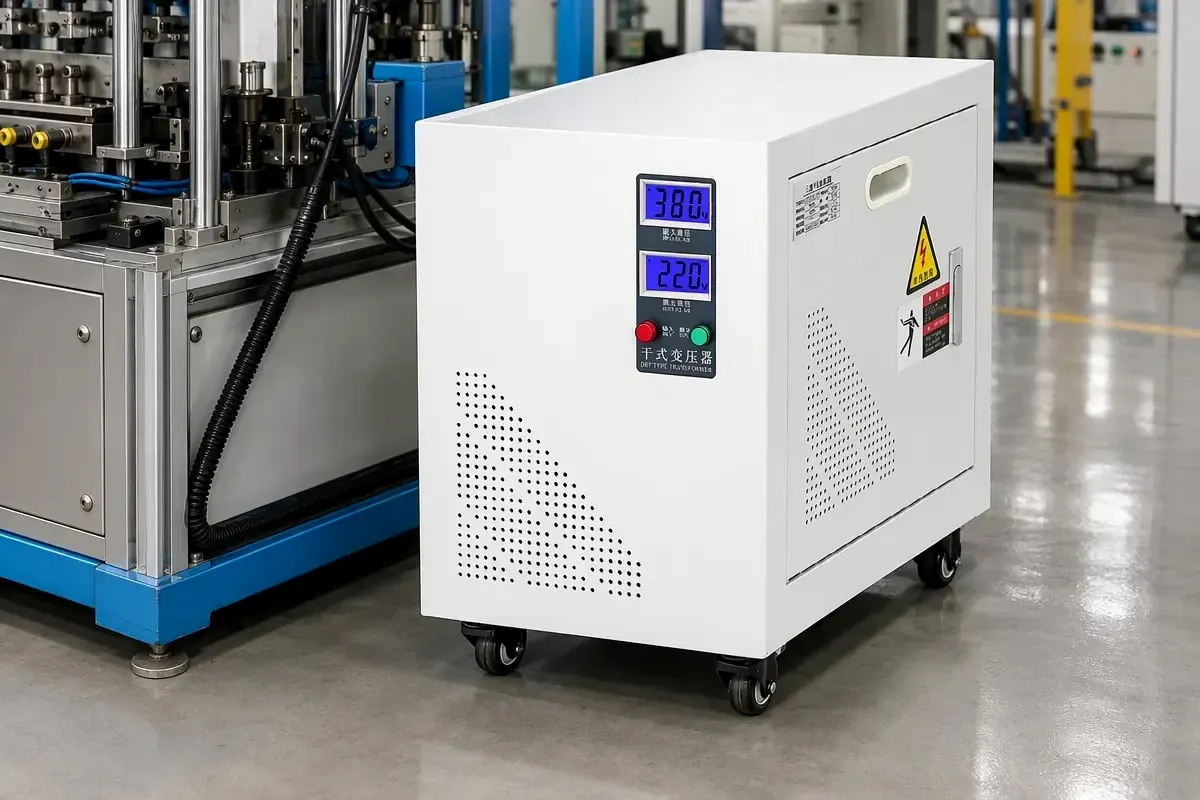
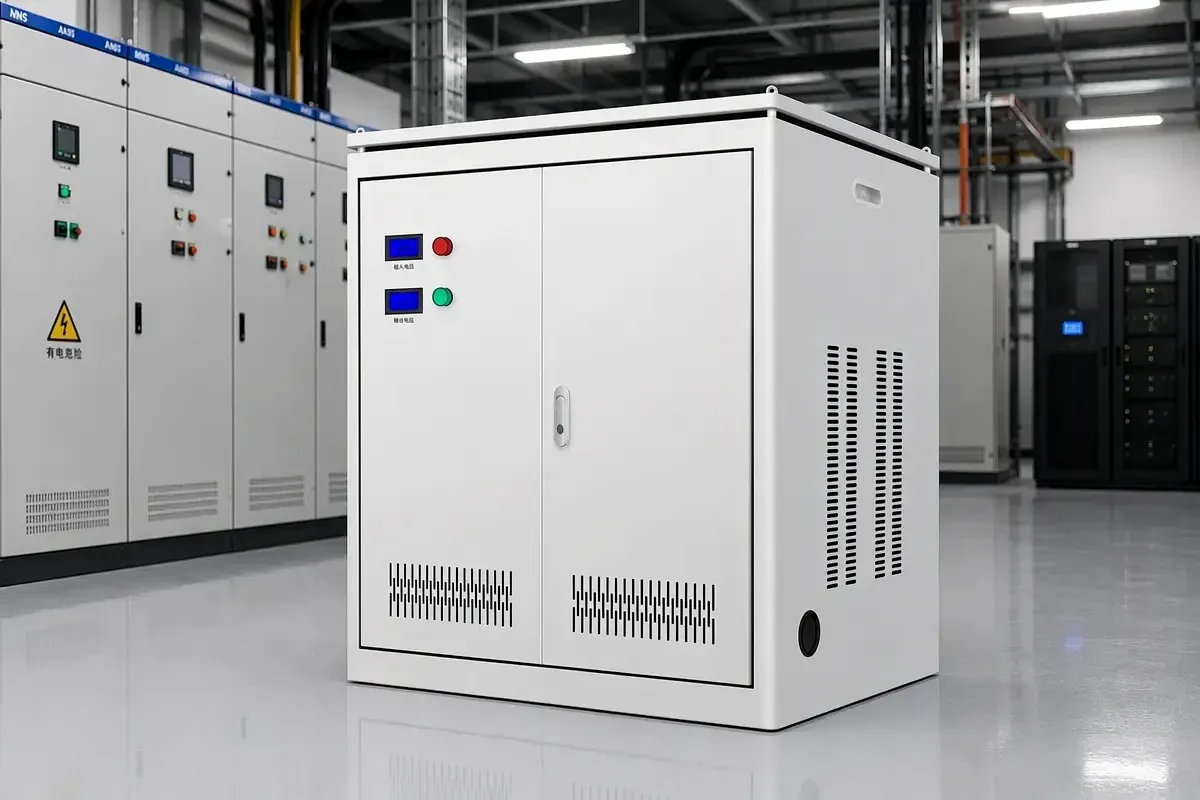
Fit a fixed ratio. On a stable 440V or 415V supply the OSG three-phase dry-type autotransformer does it with one winding at about 99 percent efficiency, from 10kVA to 100kVA, Y-connected and air-cooled, with 380/660/440/220V among its default inputs. It does not regulate, so output tracks input.
Or fit a wide-input stabilizer. Where the grid is the moving part, conversion and regulation can be one device. The SBW servo stabilizer accepts AC 304-456V, which brackets 400, 415 and 440, and holds 380V ±3 percent from 50kVA to 800kVA. It costs more, has moving parts; in exchange one unit covers a site whose voltage is not one number.
Separate the small loads. Instruments behind the cabinet complain first; a single-phase isolation transformer in the ODK range covers 300VA to 2000VA at 220V to 220V, Class F insulation, 2500V withstand. It converts nothing, and fits after the incoming voltage is settled, as in power for automation and machining.
Where this stops working
Frequency. A 60Hz machine on a 50Hz supply at 400V is over-fluxed by 20 percent; a step-down makes it worse by cutting voltage without touching frequency.
Soft grids. A fixed ratio multiplies whatever arrives: a 440-to-380 unit on a feeder sagging to 340V gives about 294V.
Isolation. An autotransformer shares one winding, so primary and secondary stay connected. Where a separated secondary with its own earthed neutral is required, the ratio is irrelevant; see isolation transformer 380 to 220.
The short version
Between 380 and 400V, use the machine tappings. At 415V, re-tap and measure before buying. At 440V, convert: fixed ratio on a steady supply, a wide-input servo stabilizer on a moving one, isolation only when the specification asks for separation. If the machine is 60Hz, the problem was never voltage.
Technology · Selection