
Data Center Static Stabilizer vs Servo: IT Load Response
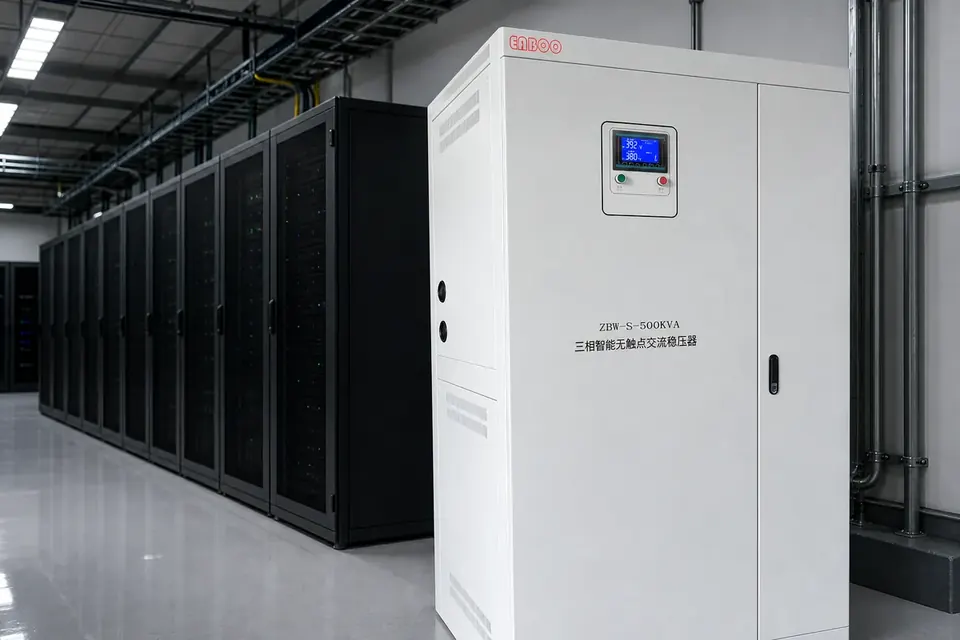
The room that alarms when the chiller starts
A colocation room carries 180kW of IT load on two PDUs. Each morning at ten, as the chiller plant stages a second compressor, the incoming panel records the same shape: 402V before, 352V for about 150 milliseconds, then back. The racks ride through, because the UPS is online. The mechanical panel does not: one contactor drops out, the chilled-water loop stops, and forty minutes later the room is on a heat alarm. Nothing failed; the supply moved faster than the equipment in front of it could follow.
Why one second is already too late
A servo stabilizer corrects by driving a carbon brush along a variable transformer. Continuous and accurate, but mechanical: the brush travels in volts per second, so a 20V step takes most of a second, then the motor must settle without overshooting. A static stabilizer switches with thyristors, with no travel and no inertia, so a full correction lands within one or two mains cycles, 20 to 40 milliseconds at 50Hz.
Two orders of magnitude separate them, and that difference, not accuracy, decides the application. The load cares about the 150 milliseconds when the voltage is wrong, not the average over a minute.
The numbers that decide the specification
Take the event, not the nominal: the deepest 100 millisecond dip and its duration, from the log. If it is shorter than a candidate's correction time, that machine does nothing.
Size on the bottom of the input window. At 304V input a unit draws about 1.25 times its output current, so a cabinet that looks generous at 380V runs at its thermal limit at the window floor. Keep measured demand under 70 to 80 percent of rating at the lowest expected input.
Measure phase balance before paying for per-phase regulation: single-phase rack loads are split by whoever patched the panel, and a 10 to 20 percent spread is ordinary.
Count the heat: 500kVA above 95 percent efficiency rejects about 25kW into a room held at 24 degrees.
Three ways to hold the voltage
Static, per-phase, with seamless bypass: the ZBW-S static stabilizer covers 10KVA to 3500KVA at AC 304-456V, regulates each phase independently, with accuracy from plus or minus 1 to 3 percent, efficiency above 95 percent and thresholds at 425V and 342V. Its advantage here is timing, not accuracy: correction completes before the event does, and a machine running 8,760 hours a year has no brush to service.
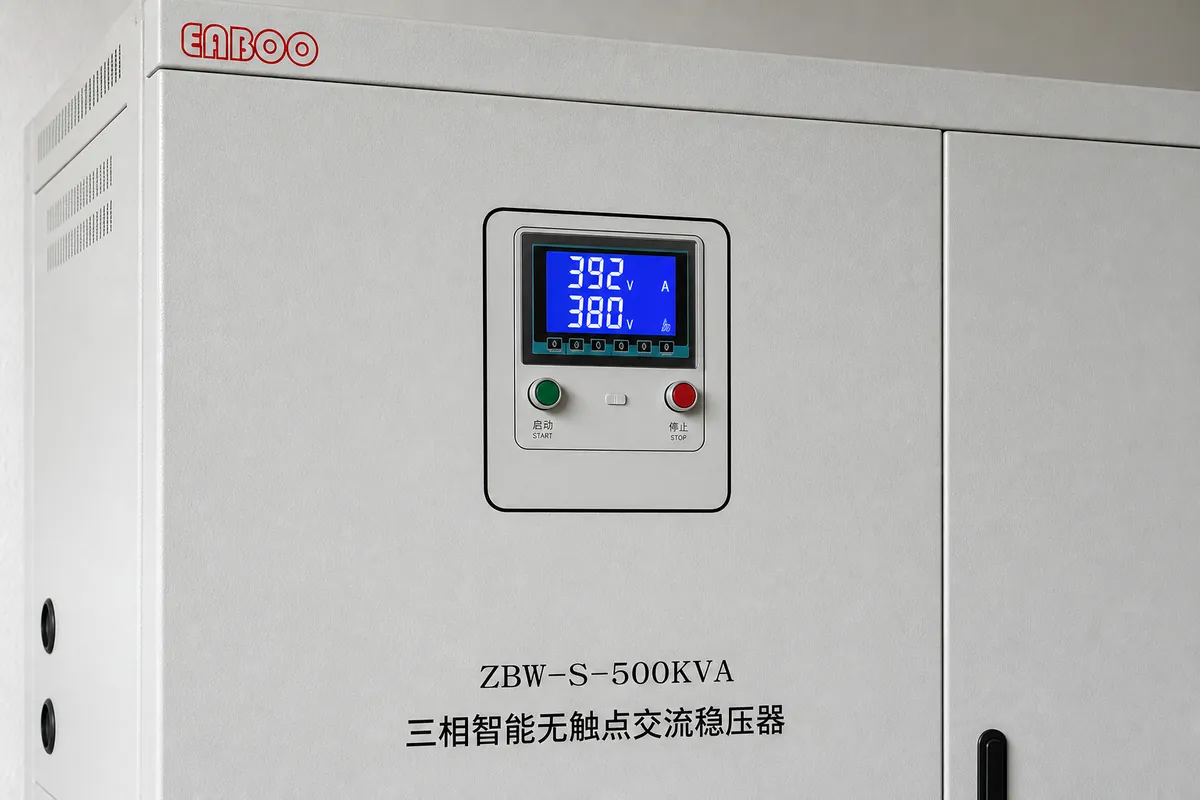
Servo: the SBW power stabilizer runs 50KVA to 800KVA at AC 304-456V with 380V plus or minus 3 percent, for motor-driven loads and slow drift, where a maintenance window exists for the brush.
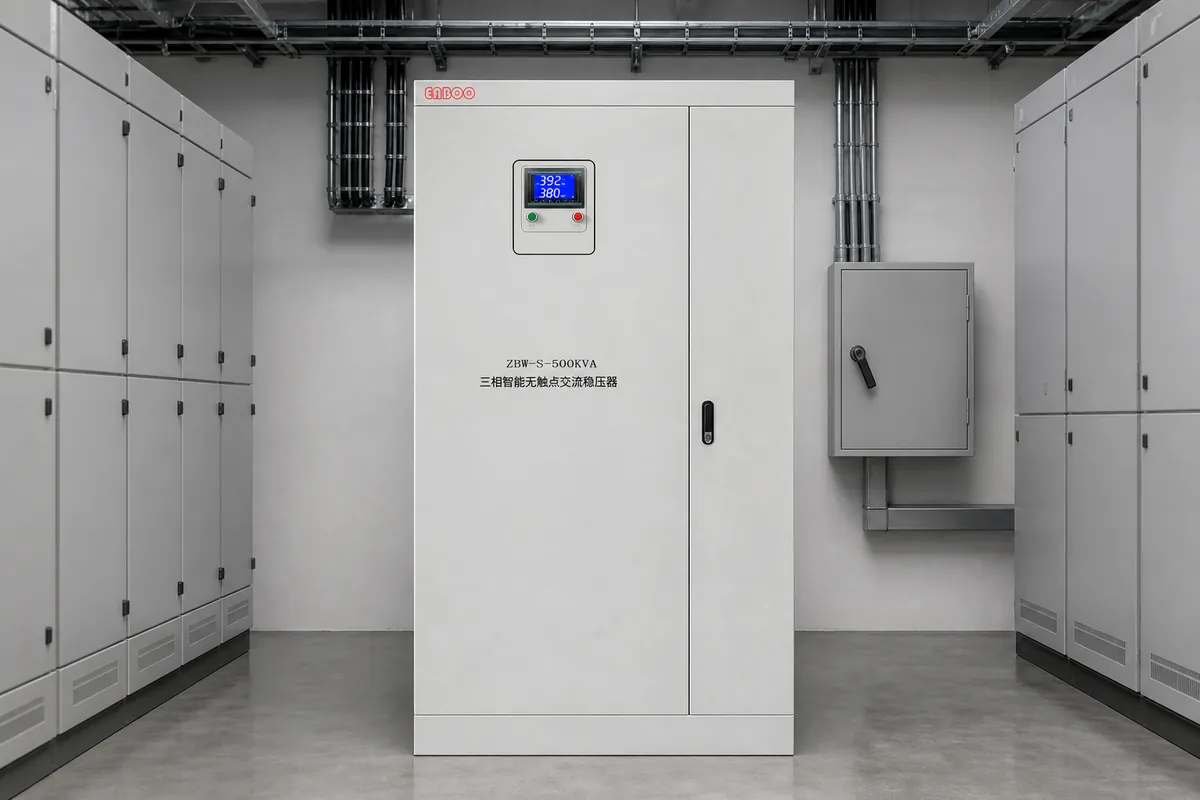
Or buy nothing: a steady offset is a tap change upstream.
Where this reasoning stops
A stabilizer corrects voltage, nothing else. An outage or a source transfer belongs to the UPS and the generator; one in series adds a failure point without ride-through. Common-mode noise or an unstable neutral needs an isolation transformer; correcting the RMS value does nothing for a 3V noise floor. Harmonic distortion passes through: the series transformer must be rated for the current, but no regulator removes it.
Above 40 degrees, or boxed in with no clearance, the unit derates. A compressor on the same board reads as an undervoltage event and can throw the board to bypass; separate the circuits. Severe imbalance has limits too; rebalancing the panel beats regulating around a wiring error.
What to specify
Read the log: the deepest 100 millisecond dip and how long it lasted. Shorter than a second, with the room running continuously, specify a static per-phase unit with seamless bypass, sized at the bottom of its window and derated for its heat. Drifting over minutes with motor load, a servo cabinet is adequate and cheaper. Outages rather than dips, and the budget belongs to the UPS. For the chain around the regulator, see the railway information room power cabinet layout and the comparison of relay, servo and SCR regulation.
Technology · Selection · Industrial