
Relay vs Servo vs SCR Voltage Stabilizers
Relay: tap switching through contactors
Relay stabilizers switch transformer taps through relays. Correction happens in steps of roughly 10 to 15 V, response is fast enough for general loads, and there is no motor or brush to wear. Accuracy is typically plus or minus 8 to 10 percent, which suits office, household and general commercial equipment. What buyers rarely check first is the input window, and that is where the relay family is strongest: the TM relay-type stabilizer accepts AC 100-260V from 500VA to 5KVA, the WTM wide-input model starts at AC 80V from 1KVA to 10KVA, and the BTM cabinet version puts the same regulation in a vertical cabinet with input-current and fault-record readout for wall-mounted or stand-alone installation.
Servo: continuous brush regulation
Servo stabilizers move a carbon brush along a variable transformer with a motor. Correction is continuous, accuracy reaches about plus or minus 3 percent, and the output stays smooth under slowly changing supply. The trade-off sits in the input window, not in the accuracy: the SVC servo-type stabilizer and the TND range are specified at AC 150-250V as standard, and the three-phase TNS servo-type stabilizer at AC 260-450V for 15-20KVA and AC 304-456V from 30KVA up. On a feeder that sits at 110V all evening, a standard servo unit cannot start regulating at all, while a relay unit still holds the load. The brush is a wear part and needs periodic inspection, which is normal maintenance rather than a fault.
SCR: static regulation in milliseconds
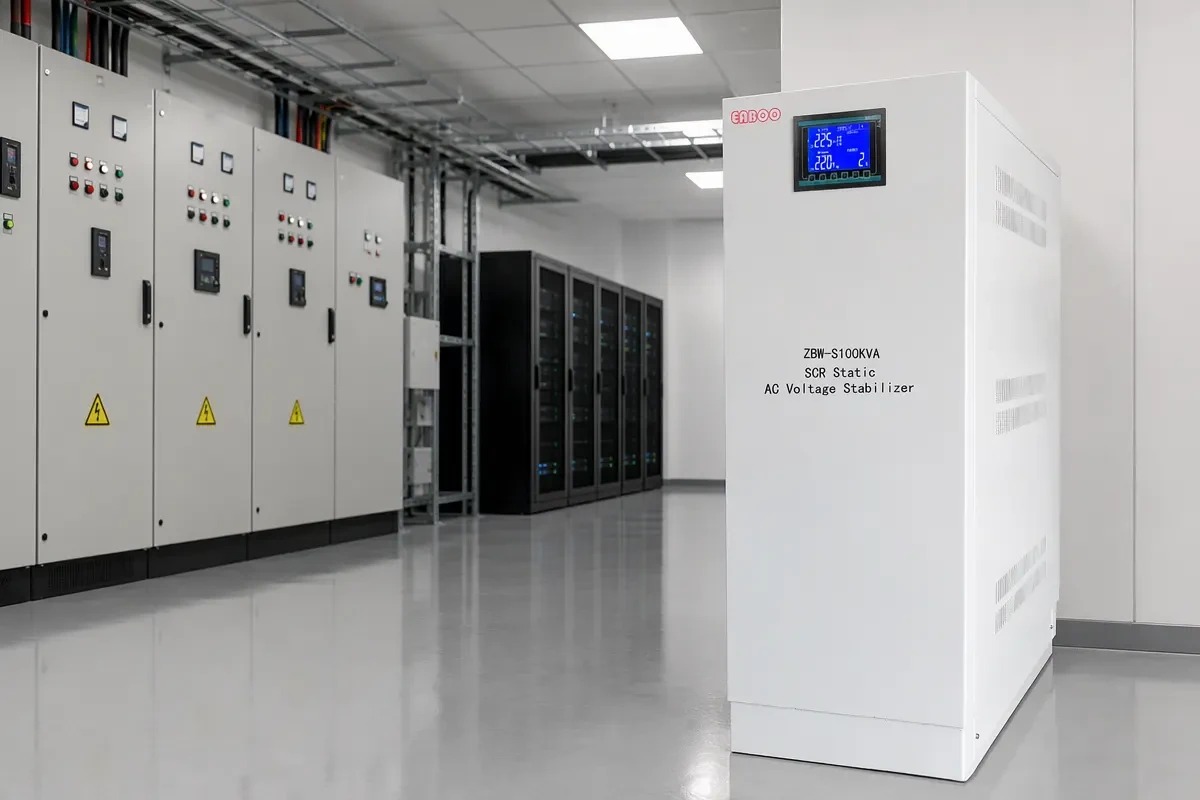
SCR static stabilizers regulate with thyristors and no moving parts. Response is in the millisecond range and accuracy can reach plus or minus 1 percent, with three-phase models regulating each phase independently. They suit precision instruments, medical imaging and production lines where a mechanical wear part is unacceptable. The ZBW-S static stabilizer covers 10KVA to 3500KVA at AC 304-456V with per-phase control and a seamless bypass to mains.
The input window decides more than the accuracy figure
A buyer comparing datasheets tends to rank technologies by accuracy: 1 percent looks better than 3 percent, which looks better than 8 percent. On a weak grid that ranking produces the wrong purchase. The number that decides whether the equipment stays powered is the lowest input voltage at which the unit can still hold its rated output. A plus or minus 8 percent relay unit specified at AC 80-260V will regulate an 85V feeder within its window; a plus or minus 3 percent servo unit specified at AC 150-250V will simply refuse to work and trip to bypass or protection. Accuracy only matters once the unit is regulating at all.
A practical order for comparing three offers: first the input window against the measured site voltage, second the rated current at the lowest input voltage, third the accuracy, fourth the price per kVA. If the first number fails, the rest are irrelevant.
Response speed: who actually notices it
Correction speed only matters when the load changes faster than the regulator. A relay unit steps in 10 to 15 V increments and corrects within a cycle or two of a tap change, which is invisible to lamps, motors, chargers and most office equipment, but visible as a small flicker on incandescent lighting and audible as contactor clicks. A servo unit corrects continuously and slowly, so it is smooth on a slowly drifting feeder and lagging on a load that switches every second. An SCR unit corrects within milliseconds, which is what a medical imager, a laboratory instrument or a high-speed production line actually needs. Paying for millisecond response on a household load buys precision that nobody measures.
Wear parts and the ten-year cost
Relay units have contactors with a finite switching count and no motor. Servo units have a motor and a carbon brush that is replaced on a schedule. SCR units have neither, but carry the cost of the thyristor stack and the control board. Asked to compare on purchase price alone, the relay unit usually wins; asked to compare on ten-year cost including brush replacement, downtime and spare parts, the gap narrows; asked to compare on the cost of a stopped production line, the SCR unit wins. The honest answer is that none of the three is cheaper in general - each is cheaper for the load it was designed for.
What to specify before you order
Four numbers make the choice unambiguous, and all four come from the site rather than from a catalogue: the measured incoming voltage at no load and at full load, the load type and whether several motors can start together, the required output accuracy, and the environment the unit will sit in. Send those four and the technology follows from them. If the load is household or small commercial on an unstable feeder, the single-phase stabilizer range covers it from 500VA to 60KVA. If the units are going out under your own brand, the input window, panel language, socket standard and carton are all configurable through OEM production.
Choose by what the load tolerates
Choose by what the load tolerates, not by price alone: a relay unit on a printing line will chase voltage in steps, while an SCR unit on a household load spends money on precision that nobody measures. On a supply that drops below the servo window, only the wider-input relay unit keeps the load running at all - and that, not the accuracy line, is the specification that decides the order.
Technology · Guide