
SBW Stabilizer on a Diesel Generator: Sag and Sizing
A transfer that lasted eleven minutes
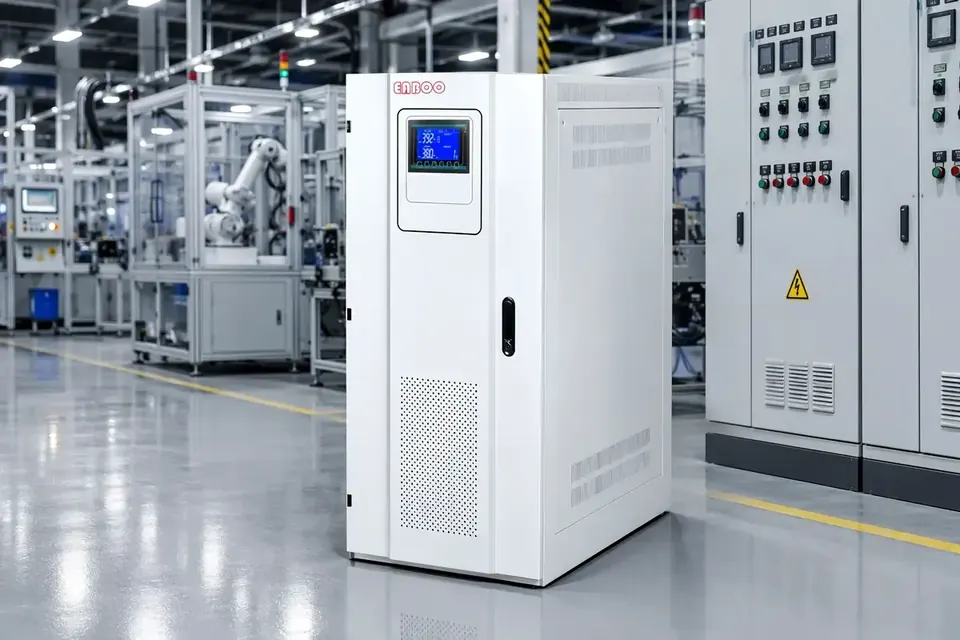
A packaging plant loses mains at 06:40. The 250 kVA standby set starts, the changeover closes, and the stabilizer on line 2 goes straight to full boost. Output sags to 312 V, the contactor drops on undervoltage, and the plant runs the morning on the load ahead of the cabinet. Nothing failed: the set was sized for average load, the stabilizer for a stiff grid.
A generator is a soft source, and the input window is fixed
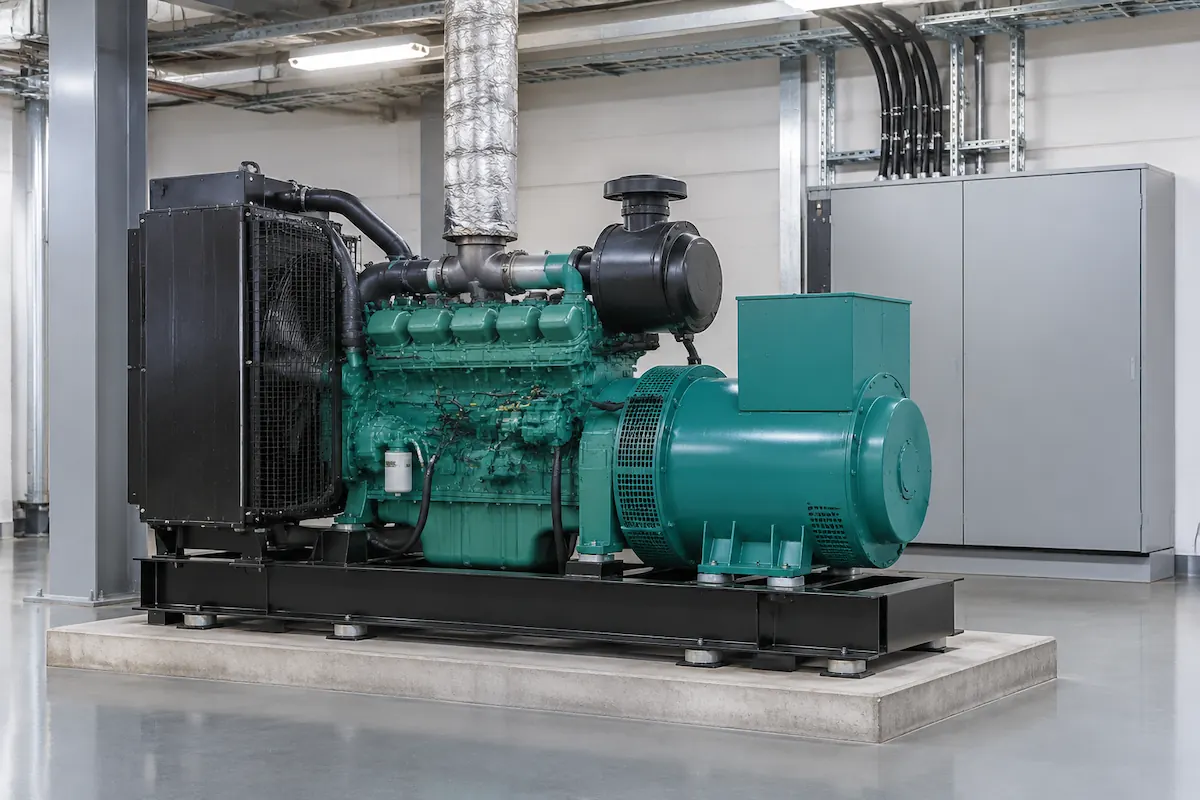
On mains a 100 kVA step moves voltage by a fraction of a percent, because the transformer behind it is a hundred times larger. On a set the same step meets subtransient reactance, 10 to 20 percent: voltage follows Ohm's law until the AVR catches up. The dip is roughly step divided by set rating, times that reactance — 100 kVA onto 250 kVA at 15 percent drops about 6 percent, and field readings are worse.
The stabilizer sees volts, not a percentage, and corrects only inside its window: AC 304-456V on the SBW and SBW-F ranges, minus 20 to plus 20 percent around 380 V. A 25 percent dip takes 380 V to 285 V, under the floor, and the servo sits at the end of its travel while the output follows the input down. That is the 312 V.
Frequency couples in too. A loaded set drops to 47.5 or 48.5 Hz, and a transformer asked for 380 V at 47 Hz runs a higher volts-per-hertz ratio than at 50 Hz: the core moves toward saturation, magnetizing current climbs, and the set carries load it never saw on mains. Its waveform also carries 8 to 12 percent voltage THD, which the regulator passes straight through.
Two sums before anything is ordered
Dip at the largest step. Divide the biggest load that switches at once by the set rating, multiply by subtransient reactance. Keep it under 15 percent for the stabilizer to stay inside its window.
Capacity on both sides. The set must carry running load, stabilizer losses and the starting current of the largest motor. The stabilizer is rated for the load, not the set: sizing it to the generator only adds idling losses and heat.
Three ways to make the pair work
Size the set for the step. One and a half to two times the largest step is the usual range where the load also starts motors. It costs more than a bigger cabinet, but it keeps voltage inside the window when the step lands.
Delay the load, not the regulation. Hold the load off for ten to fifteen seconds after the changeover, until engine speed and AVR settle. A stabilizer starting from a rising input never runs to the end of its travel.
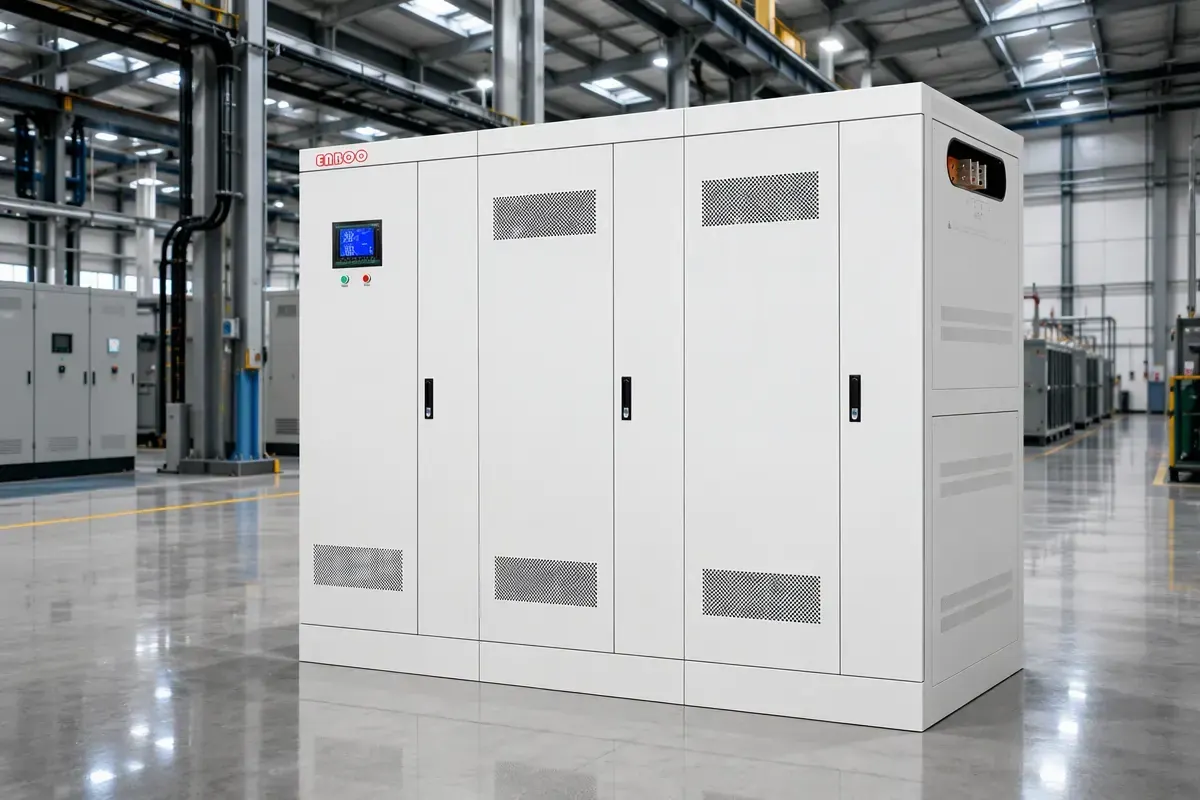
Match the regulation to the load. SBW servo stabilizers hold plus or minus 3 percent from 50 to 800 kVA, for mixed motor and resistive load. Where single-phase load is uneven, SBW-F split-phase cabinets regulate each phase independently from 60 to 800 kVA. Both accept AC 304-456V and run at 50 or 60 Hz; manufacturing applications covers the same cabling on mains.
Where this stops working
A stabilizer corrects voltage, not frequency. On a small set the frequency is the worse number: 47 Hz reaches a motor as a speed problem and a UPS as a synchronisation problem before voltage matters.
A set is a separately derived source: its neutral is bonded at the generator, not at the service entrance, so earth fault paths and residual current devices behave differently once the changeover closes.
Two slow loops also fight. A stabilizer rated close to the set will hunt: the AVR pushes up, the servo pulls down, output swings at a fraction of a hertz. Below about 1.3 times the stabilizer rating, expect it. The same failure mode ends the 40 V drop case in another topology, not a tighter setpoint.
What to specify
Match the set to the step, hold load off until it is stable, and rate the stabilizer for the load. Mixed load means SBW; uneven phases mean SBW-F. If measured dip stays under 15 percent, the pair behaves like mains with a slower recovery. Where the risk is an inverter dropping out, start with inverter overvoltage trips.
Technology · Selection · Industrial