
Stabilizer for Elevator: Sizing Motor Start Inrush
One start, one flicker
A twelve-stop building, an 11 kW geared traction machine, a 15 kVA stabilizer sized off the nameplate. Every time the car leaves the ground floor the lobby lights step down for a second, and one start in twenty the stabilizer drops out and the controller reboots. The elevator is fine; the device bought to protect it is the part failing.
A motor at standstill is a shorted transformer
Before the rotor turns, slip equals one and a cage motor behaves like a transformer with its secondary shorted. Line current reaches five to seven times rated within a few cycles, then decays as the rotor accelerates; on a geared machine the event lasts one to two seconds. Power factor at standstill is 0.2 to 0.35, so most of that current is reactive: no torque, only voltage drop, seen by everything on the same feeder.
A servo stabilizer cannot answer that. It samples output voltage and drives a motor to move a variac brush, which has a finite travel speed. Minutes-long drift it tracks; a dip that appears and vanishes inside two seconds is over before the brush moves, while the series winding carries six times rated current.
Choosing a stabilizer for elevator duty: four numbers
Rated current. P over root 3, U, efficiency and power factor: 11 kW at 400V, 0.88, 0.85 gives 21A, or 14.7 kVA, not 11.
Starting current by method. Direct-on-line 5 to 7 times rated, 105 to 147A here. Star-delta about a third of that on the line side. Soft starter 2 to 3.5 times. A drive holds the motor at 1.2 to 1.5 times and draws near rated input current.
Dip depth. Short-circuit power is transformer kVA over impedance: 400 kVA at 4 percent is 10 MVA, so an 88 kVA start costs under 1 percent and the transformer is rarely the culprit. Long feeders and thin cables are. Measure at the elevator terminals, stabilizer in circuit and bypassed.
Duty. 150 starts an hour at 1.5 s is 225 s of inrush per car per hour, about 6 percent of the time at six times current; squared and averaged, twice the heating of running at rated current all day. No continuous kVA figure describes that.
Match the curve, not the number
The question is not how many kVA but what the short-time overload curve allows. A 15 kVA unit rated 1.2 times for 60 seconds cannot pass 88 kVA for 1.5 seconds.
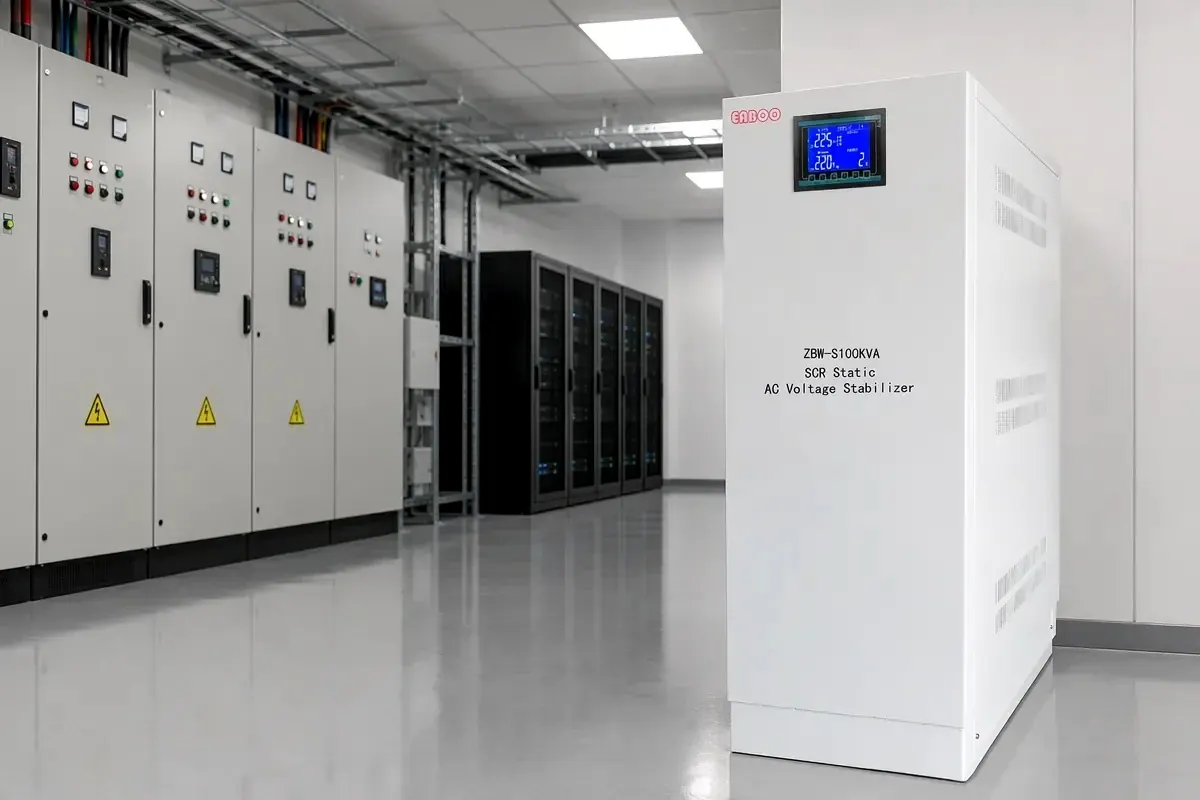
Keep the drive, size to its input. A drive-fed elevator already limits starting current, so the stabilizer covers the drive and machine-room load only. Drive input current plus 20 to 25 percent is about 18 kVA here, inside the ZBW-S static stabilizer range that starts at 10 kVA, not the SBW servo stabilizer range that starts at 50 kVA.
Behind a star-delta or soft start, regulate statically. Per-cycle correction compensates the dip while it happens; per-phase control matters when one phase sags further than the others.
Not in front of direct-on-line. A series winding would have to pass locked-rotor current; convert the starter.
Where this stops being true
An upstream dip cannot be removed by a stabilizer at the elevator feeder, which adds series impedance of its own; bypass it and measure again before buying.
A stabilizer holds voltage, it stores no energy. Ride-through and brake release timing are UPS questions.
Regenerative braking has nowhere to go; the drive still needs its braking resistor or regeneration unit.
Several cars on one unit is arithmetic, not diversity: fire recall starts them together.
None of this fixes a loose neutral, a burnt terminal or a 60 Hz machine on a 50 Hz supply.
What to specify
Carry measured dip, starts per hour and starting method into the enquiry, and size on drive input current plus a quarter where a drive is fitted; a servo unit behind star-delta or soft start only works if its overload curve covers the start. How to size a stabilizer from nameplate data covers the load side, relay, servo and SCR compared the three regulating principles, and elevators in commercial buildings fall under general industrial and commercial power.
Technology · Selection · Industrial