
Marine Voltage Stabilizer: 60 Hz, Salt Air, Imbalance
A berth that lifts the voltage after midnight
An offshore supply vessel takes shore power at a berth used for years. At noon the shore box reads 431 V; at two in the morning, galley closed and crane idle, the same box reads 462 V and the crane's soft starter trips on overvoltage. At sea the ship's generator holds 440 V inside one percent.
Why the voltage climbs when the load leaves
The berth transformer is tapped for the busy hour, so at light load its secondary sits three to five percent high. What the vessel sees tracks the rest of the quay; the band is asymmetric, deep sags when a neighbour starts a thruster, a gentle rise overnight.
Frequency is the second mechanism, and the most-missed. Core flux follows voltage divided by frequency, so a 60 Hz design pushed onto 50 Hz saturates, and a 60 Hz motor on a 50 Hz supply loses a sixth of its speed. A servo stabilizer regulates rms voltage and is indifferent to frequency, which is why it cannot repair a frequency error.
Third, on board: galley, air conditioning, lighting and chargers are single-phase loads across a three-phase system, so the phases drift apart and third harmonic current loads the neutral harder than the phases.
Three numbers before buying a marine voltage stabilizer
The window, against the real nominal. A 440 V berth at ten percent tolerance spans 396 to 484 V; a standard 304–456 V window covers 31 percent below 440 V but only 3.6 percent above, so 462 V passes straight through. Log the box loaded and unloaded for a day; a wider window is a build option.
Capacity in current, not kVA. Two hundred kVA is 262 A at 440 V and 304 A at 380 V. Size on the current at the voltage the load will see, then add starting current: five to seven times rated for one to three seconds on a directly started crane. Continuous kVA and short-time overload are separate numbers.
Neutral and imbalance. Where single-phase load dominates, specify a neutral at 1.7 times the phase conductor, since triplen harmonics add there instead of cancelling, and decide whether the phases are regulated together or separately.
Three ways to hold the voltage on board
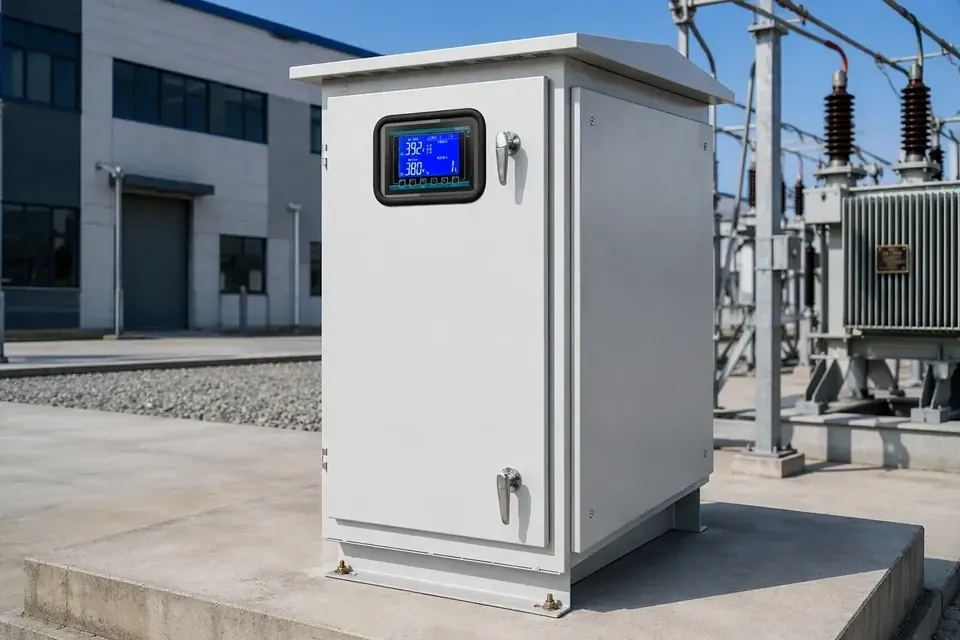
At the shore connection. A weatherproof cabinet on a plinth sits where the voltage is actually wrong. The SBW-H outdoor voltage stabilizer covers 60 to 300 kVA, 304–456 V in, 380 V ±3 percent out. Weatherproof is not a corrosion specification: say so in the enquiry.
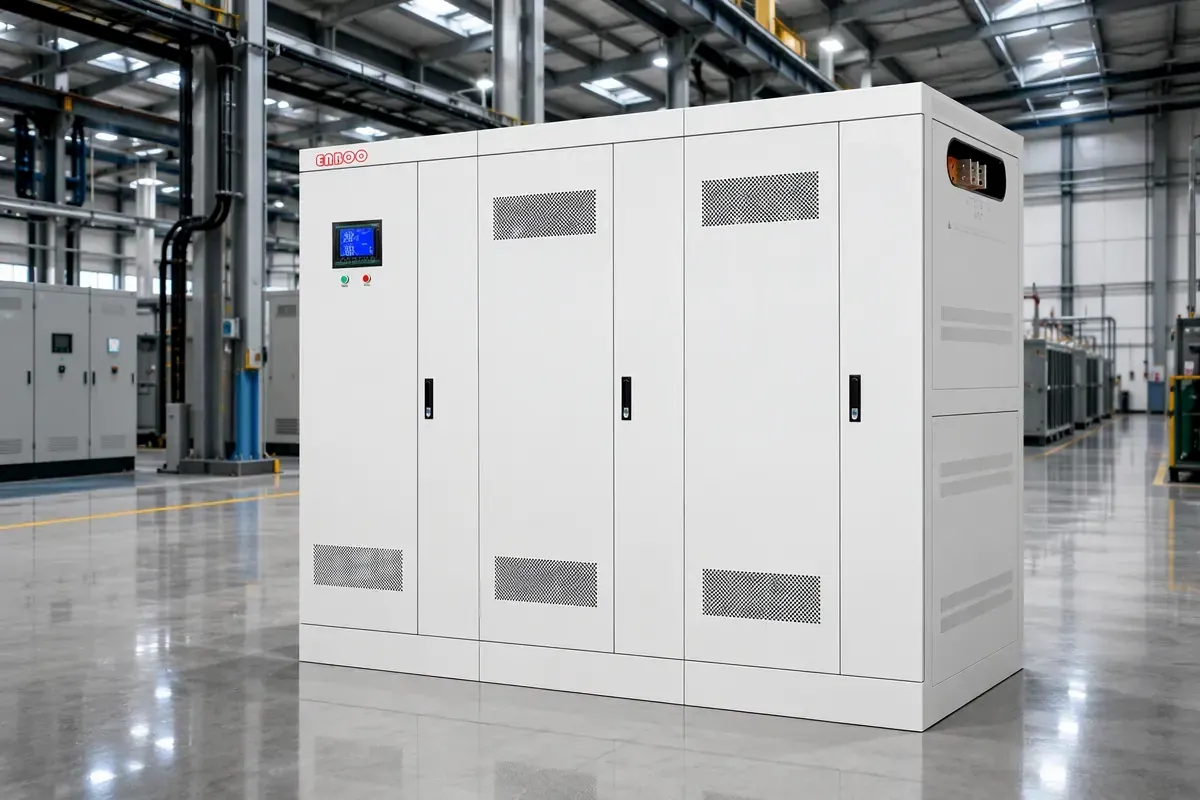
Inside, when the load is unbalanced. A single-phase galley and accommodation on a three-phase engine room drift apart under load. The SBW-F split-phase voltage stabilizer regulates each phase independently, 60 to 800 kVA on the same window.
On the instrument bench. Navigation and radio benches want a clean earth and no metallic path back to the hull. The ODK isolation transformer is a 300 VA to 2000 VA bench unit, 220 V to 220 V, Class F, at least 2 MΩ, 2500 V withstand for one minute, rated −15 to +40 °C. It separates but does not stabilise.
Where this stops working
Frequency. No stabilizer turns 60 Hz into 50 Hz; speed, torque and losses move with it, and only a converter changes that.
Vessel-rated isolation. Separating from the quay needs a transformer at the incoming shore rating, not a bench unit.
Ride-through. A stabilizer corrects steady error and stores no energy; changeover belongs to an ATS and a UPS.
Upstream causes. If 462 V comes from the berth tap, correcting it on board means absorbing the excess as heat all night. Fix the tap first.
Salt and class. Weatherproof keeps rain out but defines no corrosion class, and regulation is not an approval; put both in the enquiry.
Conclusion
Log the shore connection for a day and compare the extremes with the window you are buying, not the nominal. If the band is asymmetric, widen the window rather than adding kVA. Outdoor cabinet at the berth, per-phase regulation where hotel load dominates, isolation only where needed; frequency conversion and shore isolation are separate purchases. The shore version is in export equipment on 400 V, 415 V and 440 V grids; the workshop version under general industrial and commercial supply.
Selection · Technology · Industrial