
Neutral Current Harmonics: What ZBW-S Can and Cannot Fix
A neutral bar hotter than the phases
A four-wire board on an office floor reads 180 A per phase at four in the afternoon, balanced within five percent, yet a clamp on the neutral reads 234 A and the neutral link is discoloured. Phase-to-neutral two floors away is 214 V, phase-to-phase 401 V. A stabilizer holding 400 V there would leave every number unchanged.
Why the fourth wire can carry more than a phase
Linear loads sum to zero in the neutral, which carries only imbalance. Non-linear loads break that: a switch-mode supply draws short pulses near the crest of the sinewave, three per cycle, so most of its current sits at the third harmonic. Those are zero-sequence: in a balanced system they arrive together on all three phases and add instead of cancelling. Neutral current becomes roughly three times one phase of third-harmonic current, and a load of only single-phase supplies can reach 1.73 times the phase fundamental.
The conductor then does work it was never sized for: sixteen square millimetres of copper across forty metres is about 44 milliohms, so 230 A drops ten volts before reaching the socket. Losses climb with the square of total RMS current, harmonics included, so a check on phase current alone reads low.
Three readings that decide the fix
Neutral current against phase current, on a true-RMS clamp at the busiest hour. Below 1.0 the neutral carries imbalance only. Between 1.0 and 1.3 the non-linear share is significant: the neutral must be full size, with a terminal rated for it. Above 1.3 the board needs a thermal check, because bar and link were chosen on phase current.
The spectrum, in order. A dominant third harmonic means conductor and terminal work. Dominant fifth and seventh cancel in the neutral and surface as transformer eddy loss and motor heating.
Neutral-to-earth voltage. A volt or two is normal. Above three volts at light load, look for a loose neutral upstream, which also hands a stabilizer an unstable reference.
Past five percent phase-to-neutral THD, supplies begin to derate; past eight, the neutral bar runs hot at moderate current.
Three fixes, in the right order
Conductors and terminals first. Full-size neutral over the whole run, links replaced rather than cleaned, terminals re-torqued, bar checked against measured current. The only fix that lowers the temperature, and the cheapest.
Then the source. When a transformer is specified for a load with a known spectrum, that spectrum belongs in the enquiry. The SG dry-type isolation range covers 500VA to 100kVA, and its 99 percent efficiency describes linear loading, not harmonic heating: winding and neutral are sized from measured current, not kVA.
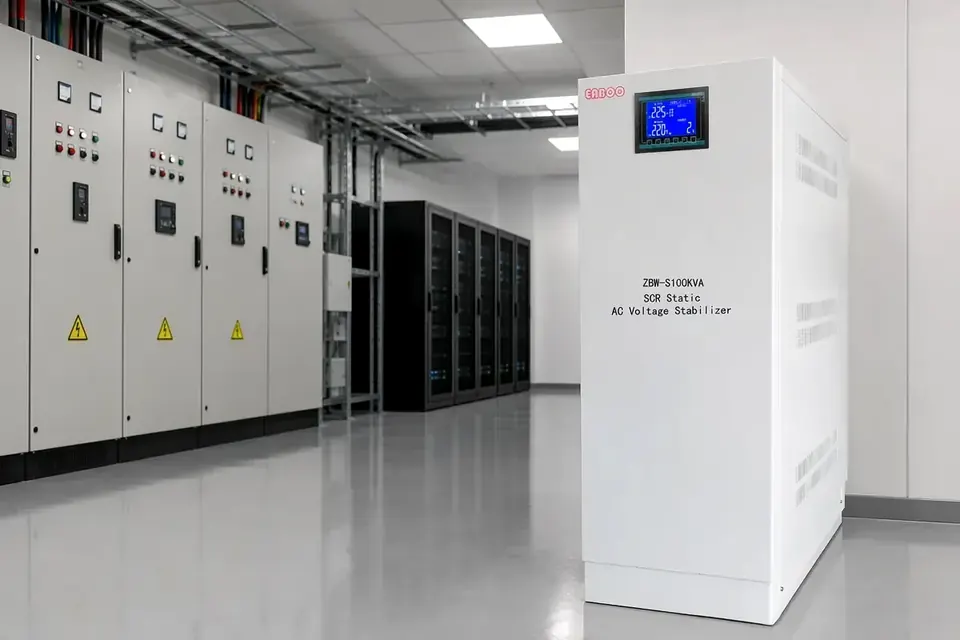
Regulation last, and for voltage only. A per-phase stabilizer holds phase-to-neutral steady against the neutral drop above. The ZBW-S static series regulates each phase independently and switches with SCRs, adding no waveform distortion of its own; models run from 10KVA to 3500KVA on AC 304-456V input with 380V output and accuracy settable to ±(1-3) percent. The SBW servo range does the same mechanically from 50KVA to 800KVA at ±3 percent.
Where this reasoning stops
A high neutral current with a clean spectrum is imbalance, not harmonics: redistribute the single-phase circuits and no stabilizer helps, as the three-phase fault guide sets out.
A stabilizer cannot remove harmonic current either: it holds the voltage the load sees while the current still heats the neutral.
On a board with an intermittent neutral, regulation fights a moving reference: stepped output, hunting, repeated trips. Repair the neutral first, and check how single-phase circuits were divided at the general commercial supply before specifying.
Conclusion
Measure the neutral before buying regulation. Below phase current with a clean spectrum, the job is load distribution. Above phase current with a dominant third harmonic, it is a full-size neutral, terminals that can take it, and a transformer winding sized from measured current. A per-phase stabilizer earns its place after those, holding phase-to-neutral where the drop eats it.
Technology · Three-phase · Industrial